The climb, the view, the timing
Mua Cave climb: steps, timing, advice
Nearly 500 stone steps to a stone dragon on the ridge: what the climb involves, what you see, when to go and where it fits on a Hanoi day tour.
See Ninh Binh tours on GetYourGuide ↗Quick answer
Mua Cave is a climb, not a cave. Nearly 500 stone steps lead up a bell-shaped limestone mountain to a ridge with a stone dragon sculpture, a pagoda and a statue of Quan The Am. The cave at the foot is small, so the view over the Ngo Dong river and the rice fields is the reason to come. Wear shoes with grip, bring water and go early or late if you can.
What Mua Cave actually is

Hang Mua tourist area is in Khe Ha village, Ninh Xuan commune, Hoa Lu city. The name suggests a cave, but the draw is the mountain above it. Ninh Binh's tourism portal describes a mountain shaped like a giant stone bell, with nearly 500 stone steps to the peak. At the top are a statue of Quan The Am Bodhisattva, a stone dragon sculpture and a Buddhist pagoda. Travel press describes the cave itself as not impressive, so treat it as a short stop on the way and the climb as the visit.
The climb
The steps are stone, and the ridge near the top is rough rock. One independent travel blog reports that the steps can be steep and uneven, that the rocks at the dragon summit are sharp, and that the steps get very slippery in rain. Take your time and rest as you need to. It is a single staircase, so you will share it with people coming down: step aside where it narrows and let them pass. Keep your phone and camera strapped to you, because you will want both hands free on the rock.
- Wear shoes with real grip, not sandals
- Carry water, especially in the hot months
- Use your hands on the rocks near the dragon, which are sharp
- Skip the climb in rain, when the steps are slippery and the view is poor
- Keep a hand free for the rocks near the top
What you see from the top
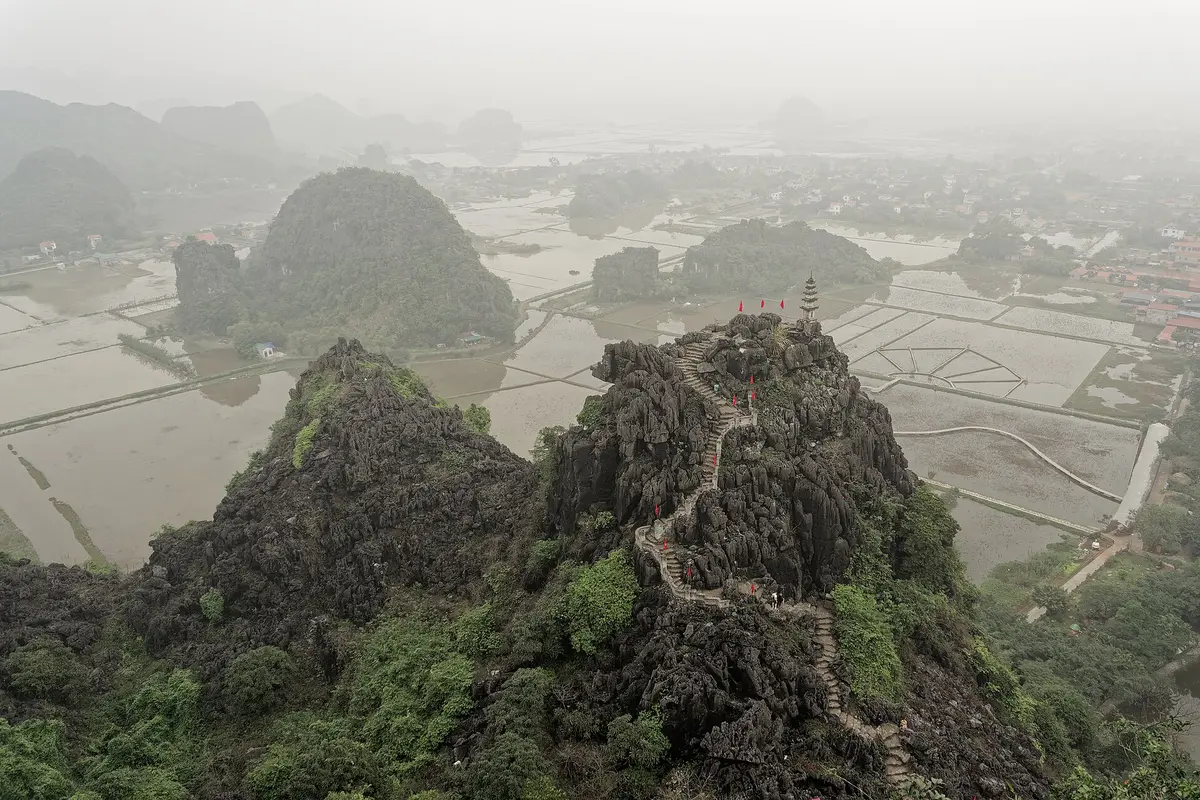
From the peak you see rocky hills stretching to the horizon with a river winding between them. You can pick out the Ngo Dong river running through Tam Coc, and on the other sides the view looks out over rice fields. Ninh Binh's tourism portal also notes the view over the old Hoa Lu region. What the fields look like depends on the season: green after planting, gold at harvest, flooded or bare in between. The dragon and the pagoda are the photo spots, and the steps and summit can get crowded at busy times.
The name and the lotus lagoon
Mua means dance. The local story, as Vietnamese press tells it, is that Tran dynasty kings came here to watch singing and dancing, which gave the place its name. At the foot of the mountain, Ninh Binh's tourism portal describes a lotus lagoon about one hectare wide, where the lotuses bloom longest around June and July. If you are visiting in summer, the lagoon is worth a look before or after the climb.
When to go: the rice seasons
Mua Cave's view changes with the rice fields. One Ninh Binh rice-field guide puts the first harvest in late May and early June, with the fields golden for about two weeks, and a second harvest from late September to mid-October. It adds that planting runs January and February, fields are bright green through March, and the fields sit empty in mid-June to mid-July and again in mid-October to November. Dates shift by a week or two each year. The same guide says the steps get packed during the golden harvest, which also coincides with the hottest weeks of the year.
Read next: The Best Time to Visit Ninh Binh: The Golden Rice and the Seasons
When to go: time of day
Early morning and late afternoon give the best light and cooler air, and the same guide says midday light flattens the view and the sun gets harsh by mid-morning. Gate hours and closing time vary between sources, so check at the gate and do not plan to arrive at the last minute. A booked day tour sets its own timing, and the Mua Cave climb comes late in the itinerary, after the Trang An boat. That means you do it after lunch and the boat, not at the cool ends of the day.
Getting there
On the Hanoi day tour, transport and Mua Cave entry are included. On your own, take the train to Ninh Binh station, a little over two hours, then a taxi or Grab; or take a limousine van to a hotel in Tam Coc and ride to Mua Cave from there. Ninh Binh's tourism portal lists the entrance as a per-person fee at the tourist area. We found no advance-booking system on that page, and you do not need one on the tour, since all entrance fees are included. Our day trip guide compares the tour, the train and an overnight stay.
Read next: Ninh Binh day trip from Hanoi
Mua Cave, Trang An or Tam Coc: what each gives you
The three headline stops give you different things. Trang An is the cave and temple boat ride, and it is renowned for its boat cave tours. Tam Coc is a river run through three caves on the Ngo Dong River, past rice fields, where the local women who row are known for using their feet. Mua Cave is the high view: you climb up and look down over the same valley. If you have time for only one extra stop on top of a boat ride, the climb gives you a perspective the boats cannot.
Read next: Trang An or Tam Coc? Which Ninh Binh Boat Ride to Choose
Nearby: Tam Coc and Bich Dong
Mua Cave overlooks the river that runs through Tam Coc, so many people pair the two. Tam Coc is three natural caves, Hang Ca, Hang Hai and Hang Ba, on the Ngo Dong River, with boats leaving from Van Lam village. Bich Dong, nearby, is a temple complex on Ngu Nhac mountain made up of three temples called Ha, Trung and Thuong, in ascending order, and guided visits end with a view from the top. Both are part of the wider Trang An landscape that UNESCO inscribed in 2014.
Children, older visitors and accessibility
We found no age limit for Mua Cave. The climb is nearly 500 stone steps, so decide by stamina, not by age. Ninh Binh's tourism pages describe no step-free route to the summit, so plan on stairs only. If someone in your group cannot climb, tell the tour operator before booking, because the itinerary includes the climb and gives no alternative stop.
Who this isn't for
Skip the climb if you have knee or balance problems, if it is raining, or if you are carrying a lot, such as a large daypack or a child you would need to carry. It is also a poor fit if you want caves: the cave itself is small, and the Trang An boat ride is the better way to see caves. If you only want the view and cannot climb, you can see Tam Coc's rice fields from a boat on the Ngo Dong River instead. And if you hate crowds, avoid the golden-harvest fortnight and the middle of the day.
Frequently asked questions
How many steps are there at Mua Cave?
Nearly 500 stone steps, according to Ninh Binh's tourism portal. They lead to the peak, where there is a statue of Quan The Am Bodhisattva, a stone dragon sculpture and a Buddhist pagoda. Expect a steep, sustained climb, and take it slowly.
Is the cave itself worth visiting?
Not on its own. Travel press describes the cave as not impressive. The reason to come is the view from the ridge over the Ngo Dong river and the rice fields.
Is Mua Cave included in the Hanoi day tour?
Yes. The tour lists all entrance fees as included, and the Mua Cave climb comes after the Trang An boat ride on the itinerary.
What is the best time to visit Mua Cave?
Early morning or late afternoon, when the light is better and the air cooler. For golden rice fields, aim for late May and early June, though dates shift each year.
Can children or older visitors do the climb?
We found no age limit, but the steps are stone and steep, and no step-free route is described. Decide by stamina and balance, and skip it in rain.
Do I need to book Mua Cave in advance?
We found no advance-booking system on the tourism portal, which lists a per-person entrance fee. On the Hanoi day tour, the entrance fee is included.
Sources